Explore the RESONATE Atlas
– A new interactive resource maps scientifically assessed nature-based interventions around the world
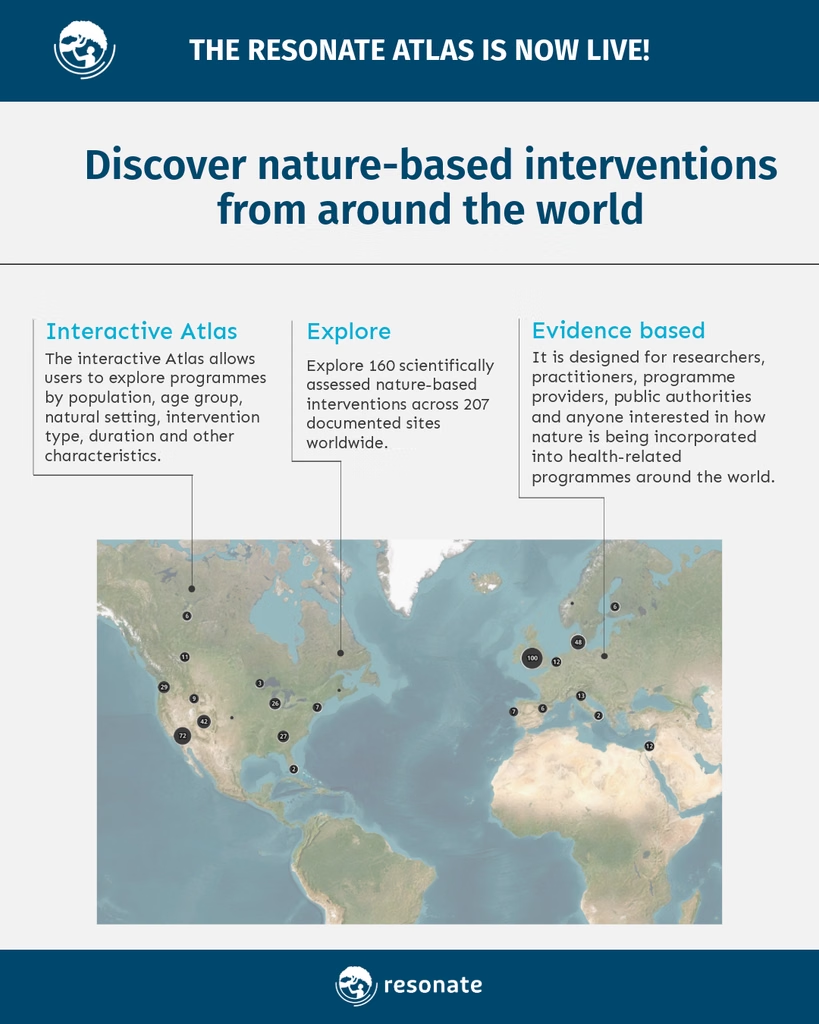
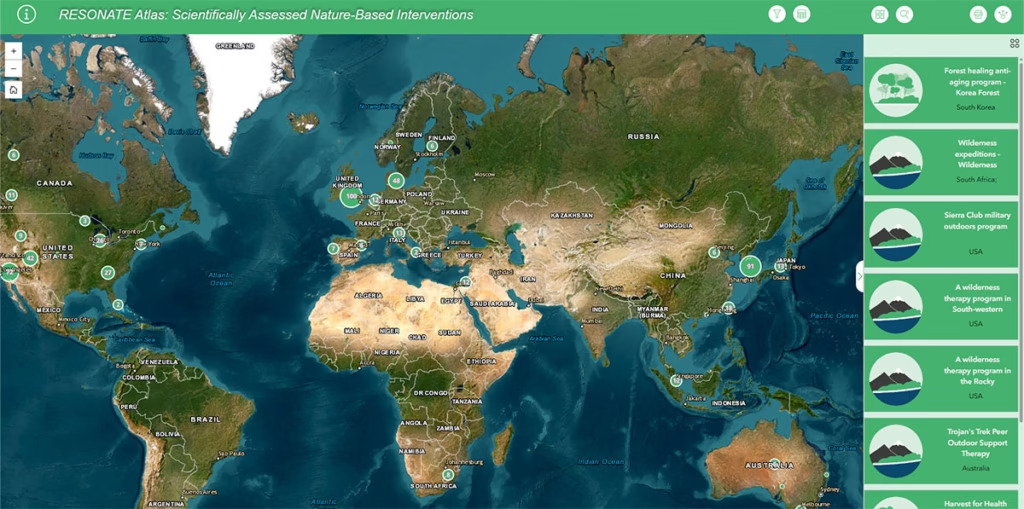
How are nature-based interventions being used to support health and well-being, where have they been implemented, and which populations have they sought to reach? The new RESONATE Atlas turns a dispersed body of scientific literature into an open, interactive resource that users can explore geographically and thematically.
Developed through the Horizon Europe RESONATE project, the Atlas brings together information from 160 scientifically assessed studies across 207 documented sites worldwide. It makes visible the breadth of approaches represented in the research, from programmes delivered in forests, gardens and urban green spaces to interventions in coastal, agricultural, and other natural settings.
From scattered evidence to an interactive map
Evidence on nature-based interventions is spread across countries, disciplines, and scientific publications, and similar programmes are often described using different terminology. This can make it difficult for researchers, practitioners, and decision-makers to obtain an overview of what has been implemented and studied.
The RESONATE team first identified eligible programmes through a structured review of the scientific literature. Information on programme characteristics, target populations, natural settings, intervention formats, delivery, and assessed health outcomes was then organised and geographically referenced.
The result is more than a static map. Users can move from a global overview to individual programme records, search the data table and filter the contents by target population, specific population, age group, gender, environmental setting, intervention type, and programme duration. Records also provide information about the outcomes assessed and the associated scientific publication, as well as programme website where available.
A resource for research, policy, and practice
The Atlas is intended for researchers, practitioners, programme providers, public authorities, and others interested in the relationship between nature and health. It can be used to discover real-world examples, compare different intervention approaches and settings, identify relevant scientific publications, and reveal populations, regions, or programme types that remain underrepresented in the available research.
For practitioners and programme developers, it offers examples of how nature-based interventions have been organised and delivered. For researchers, it provides a visual route into the evidence base and its gaps. For policy and public-sector audiences, it illustrates the breadth and geographic reach of an emerging field that connects health, social and environmental priorities.
Reaching an important milestone
“Reaching the launch feels both exciting and deeply rewarding. For a long time, this evidence existed as separate studies scattered across countries, disciplines, and journals. The Atlas allows people to see the field as a whole and to explore the diversity of approaches, find relevant examples, and also recognise where important evidence gaps remain. It has taken careful scientific review, geocoding, and many rounds of testing across the team to get here, and I am very proud that we can now make the result openly available.”
Dr Matilda van den Bosch, RESONATE WP2 lead at ISGlobal
The Atlas has developed iteratively through consortium review, user feedback, technical testing, and revisions to its content, terminology and design. Its launch marks the completion of a major RESONATE output while also creating a resource that can continue to support learning, exchange and further research beyond the project.
How to interpret the Atlas
Inclusion in the Atlas means that an intervention meets the Atlas inclusion criteria and has been assessed in at least one peer-reviewed scientific publication.
The Atlas does not rank the quality of the available evidence, determine whether an intervention is effective, or endorse individual programmes. It is not an exhaustive register of every nature-based intervention worldwide. Users seeking conclusions about effectiveness should consult the linked source publications and relevant evidence reviews.
Explore the RESONATE Atlas
The RESONATE Atlas invites users to explore how nature-based interventions are being implemented and studied around the world and to consider where research and practice might go next.