RESONATE Atlas
Discover nature-based interventions from around the world and explore the evidence behind their impact on human health and well-being. An interactive resource bringing research and real-world practice together.
About RESONATE Atlas
The RESONATE Atlas presents a global collection of nature-based interventions (NBIs) that have been implemented in real-world settings and evaluated scientifically. Developed in 2024/2025 as part of the RESONATE project – funded by the European Union’s Horizon Europe research and innovation programme, and co-funded by the UK Research and Innovation grant – the Atlas brings together evidence from peer-reviewed scientific studies into an accessible, interactive resource.
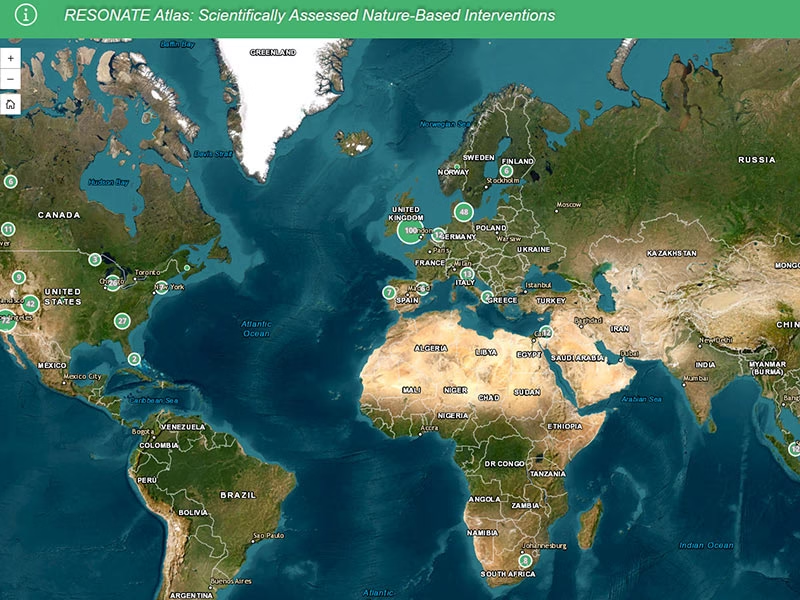
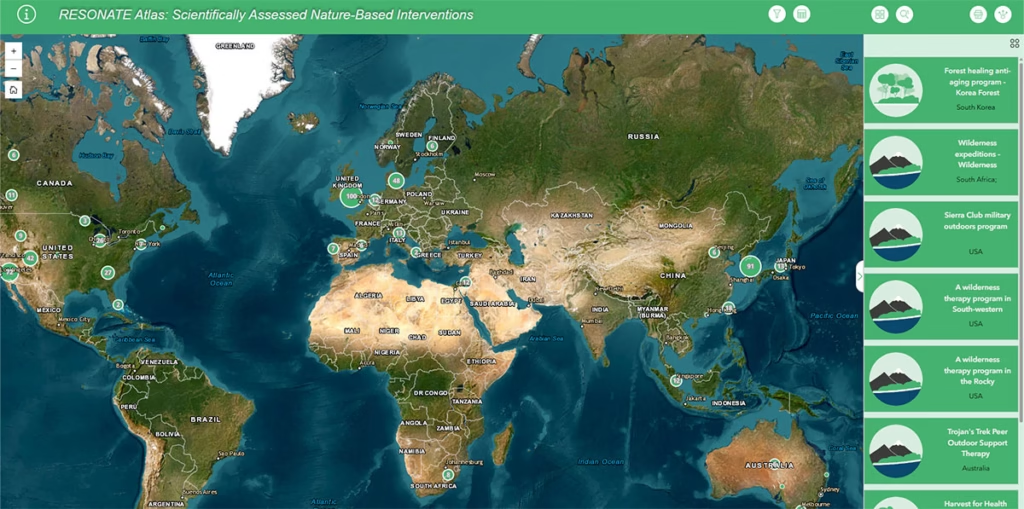
The Atlas is designed for practitioners, researchers, entrepreneurs, policy-makers, and the general public. It provides an overview of where NBIs are taking place around the world, who they are designed for, and how their impacts on health and well-being have been assessed.
By making this knowledge visible and accessible, the Atlas aims to support learning, inspire innovation, and encourage the development and scaling of evidence-based approaches that connect people with nature for improved health and well-being.
Disclaimer: The programmes included in the Atlas have all been evaluated in scientific studies published in peer-reviewed journals. However, the quality and robustness of these studies vary considerably. This means that some programmes are supported by stronger evidence than others. The Atlas does not rank or rate evidence quality directly on the map. For a deeper understanding of the strength of evidence, we recommend consulting existing systematic reviews, some of which are linked below. Inclusion in the RESONATE Atlas does not imply endorsement or recommendation of a specific programme.
- Nature-Based Intervention (NBI)
-
Programmes must qualify as NBIs, defined as planned therapeutic techniques carried out in natural settings that involve active engagement between people and nature, with the aim of improving health and well-being (Harper and Dobund 2021). Animal-assisted therapies are not included.
- Nature
-
Programmes must take place in outdoor natural settings, such as forests, gardens, urban parks, coastal areas, or mountainous landscapes.
- Established Programme
-
Programmes must exist beyond a purely research context. Interventions tested only within experimental studies, without real-world implementation, are not included.
- Scientifically assessed
-
Only programmes that have been evaluated and reported in peer-reviewed scientific publications are included.
- Literature review
-
We conducted a scoping review to identify relevant studies published between 2006 and 2023. Searches were carried out in three major scientific databases: Web of Science, PubMed, and Scopus. All information presented in the Atlas is derived from these publications
- Community support and Snowballing
-
Through a series of ‘RESONATE Spotlight’ events, additional community reach-out, and snowball searches starting from the identified literature, the database was enlarged.
- Title
-
The original programme name. If not clearly stated in the publication, a descriptive title was created (e.g. “Forest therapy programme in Tokyo”).
- Community support and Snowballing
-
Through a series of ‘RESONATE Spotlight’ events, additional community reach-out, and snowball searches starting from the identified literature, the database was enlarged.
- Age groups
-
● Children: 3-11 years ● Adolescents: 12-17 years ● Young adults: 18-29 years ● Adults: 30-64 years ● Older adults: 65+ years
- Gender
-
Reported as described in the studies (women, men, or both). No studies included reported on non-binary gender identities.
- Environmental setting
-
● Forest and woodland ● Remote and varied natural area ● Farms and agricultural setting ● Garden ● Urban green space ● Ocean, coast and beach ● Other (e.g. everyday life locations)
- Type of intervention
-
● Forest therapy / Forest bathing are immersive experiences in forests, usually incorporating various activities, such as walking, sensory stimulation, and meditation. Forest therapy often has specific treatment goals, whereas forest bathing (in Japanese Shinrin yoku) aims at promoting health and well-being for the general public. ● Wilderness/Adventure therapy are structured interventions that combine therapeutic approaches with adventurous and immersive outdoor experiences. Wilderness therapy typically involves multi-day expeditions in remote settings with activities such as backpacking and camping. Adventure therapy focuses on challenge-based activities like rock climbing or kayaking to foster personal growth and resilience. ● Horticulture therapy, Sensory gardens, and Therapeutic horticultureare structured activities in gardens. Horticultural therapy uses gardening to reach a therapeutic goal for a defined target group. Sensory gardens focus on sensory experiences in specifically designed environments. Therapeutic horticulture mainly uses gardening to promote socializingand well-being for a broad target group. ● Care farming (also social farm and healing farm) is the use of agricultural farms to support health and well-being. Activities take place either on specialized care farms or, more commonly, as a side activity on commercial farms. ● Green exercise, green gym or nature-based physical activity is physical exercise in natural settings. This may, for instance, include walking groups in nature or guided engagement in nature conservation work. ● Park prescription is health care recommendations to visit parks for improving health, mainly through physical activity and nature contact, often with a tailored activity plan. ● Surf therapy is the structured use of surfing to increase health and well-being. Surf therapy combines physical activity on the water with adventure elements in a social environment. ● Nature mindfulness is an intervention that combine mindfulness practices and contact with natural environments, using self-directed or guided meditative practices.
- Duration
-
● Short term: up to 13 days ● Medium-term: two weeks to three months ● Long-term: more than three months
- Organizer
-
The organisation(s) responsible for coordinating the programme.
- Provider
-
The individuals delivering the intervention.
- Website
-
Link to the website of an established NBI programmes if available. If website is not available, this is stated.
- Health outcomes assessed
-
The Atlas categorises outcomes reported in studies into the following domains: ● Physical health and functioning ● Physiological markers (e.g., blood pressure, cortisol) ● Psychological and emotional well-being ● Cognitive functioning ● Social behaviour and relationships ● Quality of life and life satisfaction ● Lifestyle and health behaviours ● These outcomes are evaluated based on a combination of objective measures (e.g. clinical data) and subjective assessments (e.g. questionnaires and self-reports).
- Location and mapping
-
Each programme is represented geographically on the map. Locations are based on: coordinates reported in the original publications, or additional information from web searches, or direct contact with study authors. When precise locations were not available, approximate locations (e.g., city level) were used. The numbers displayed on the map represent individual database records linked to specific intervention locations and study entries. Since some programmes were assessed across multiple sites, populations, or study components, the total number of mapped records is higher than the number of unique programmes and studies presented in the Atlas.
- Location accuracy
-
Indicates whether the mapped point represents an exact location or an approximate area (e.g. a programme with a location specificity of “Municipality or county level” takes place at an undefined place within the municipality or county in which the point is located).
Key references and additional sources
Adewuyi, F. A., Knobel, P., Gogna, P. & Dadvand, P. (2023). Health effects of green prescription: A systematic review of randomized controlled trials. Environmental Research, 236, 116844. https://doi.org/10.1016/j.envres.2023.116844
Harper, N. J. & Dobud, W. W. (Eds.). (2020). Outdoor Therapies: An Introduction to Practices, Possibilities, and Critical Perspectives. Routledge. https://doi.org/10.4324/9780429352027
Harper, N.J., Fernee, C. R. & Gabrielsen, L. E. (2021). Nature’s Role in Outdoor Therapies: An Umbrella Review. International Journal of Environmental Research and Public Health, 18(10), Article 10. https://doi.org/10.3390/ijerph18105117
Nguyen, P.-Y., Astell-Burt, T., Rahimi-Ardabili, H. & Feng, X. (2023). Effect of nature prescriptions on cardiometabolic and mental health, and physical activity: A systematic review. The Lancet Planetary Health, 7(4), e313–e328. https://doi.org/10.1016/S2542-5196(23)00025-6
Shrestha, T., Voon Yi Chi, C., Cassarino, M., Foley, S. & Di Blasi, Z. (2025). Factors influencing the effectiveness of nature-based interventions (NBIs) aimed at improving mental health and wellbeing: An umbrella review. Environment International, 196, 109217. https://doi.org/10.1016/j.envint.2024.109217
van den Bosch, M. & Bird, W. (Eds.). (2018). Oxford Textbook of Nature and Public Health: The role of nature in improving the health of a population. Oxford University Press. https://doi.org/10.1093/med/9780198725916.001.0001